


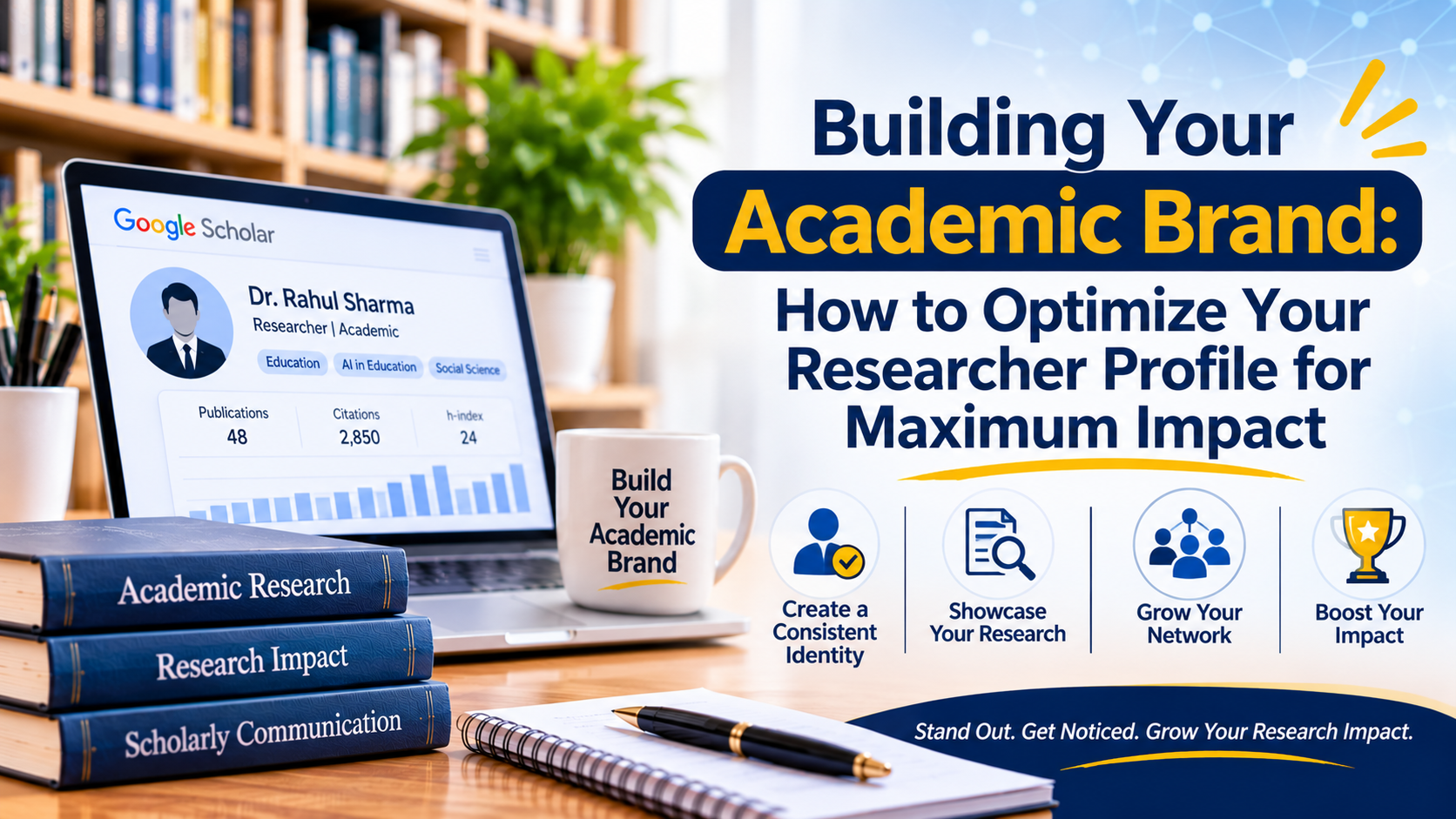
Building Your Academic Brand: How to Optimize Your Researcher Profile for Maximum Impact
Introduction
In today's digital academic environment, publishing high-quality research is only one part of building a successful academic career. Researchers must also make their work discoverable, establish professional credibility, and connect with other scholars, institutions, and research communities.
This is where academic branding becomes important.
Academic branding refers to how researchers present their expertise, research interests, publications, achievements, and professional identity across digital platforms. A well-developed academic presence helps researchers communicate their contributions, reach a wider audience, and create opportunities for collaboration.
Platforms such as Google Scholar, ORCID, ResearchGate, institutional repositories, and academic networking communities allow researchers to showcase their work and make their research more accessible.
However, simply creating profiles on multiple platforms is not enough. Researchers need to maintain accurate information, organize their publications, share their findings, and develop a consistent professional identity.
In this guide, we explore practical ways to build your academic brand, optimize your researcher profile, improve research visibility, and establish a stronger presence in the global academic community.
1. What Is Academic Branding and Why Does It Matter?
Academic branding is the process of developing a recognizable professional identity as a researcher, scholar, educator, or academic professional.
It involves presenting your research interests, subject expertise, publications, academic qualifications, and contributions in a clear and consistent manner.
Unlike commercial branding, academic branding focuses primarily on knowledge, credibility, research contributions, and professional reputation.
A strong academic identity can help researchers in several ways:
- Greater research visibility: Makes it easier for other researchers to discover your publications and academic contributions.
- Professional credibility: Demonstrates your expertise through verified publications, qualifications, and research activities.
- Collaboration opportunities: Helps researchers connect with scholars working in similar subject areas.
- Career development: Creates a professional digital presence that may support academic applications, research opportunities, and institutional recognition.
- Wider research impact: Helps research findings reach students, academics, policymakers, and professionals.
For early-career researchers, building an academic brand is particularly useful because it helps establish a professional identity even before they have an extensive publication record.
2. Create a Consistent Academic Identity
The foundation of a strong academic brand is a consistent researcher identity.
Researchers sometimes use different name formats, institutional details, or professional descriptions across academic platforms. This can make it difficult for readers and indexing services to correctly associate publications with the same individual.
To avoid this problem, maintain consistency across your academic profiles.
Use a Consistent Researcher Name
Use the same professional name across your publications, academic profiles, conference submissions, and research platforms whenever possible.
For example, if your published research uses the name "Dr. Rahul Sharma," try to maintain that format across your professional researcher profiles.
If your name has common variations, make sure your profiles clearly identify your publications and alternative name formats where supported.
Write a Clear Academic Biography
Your academic biography should briefly communicate who you are, what you research, and what your professional interests are.
A useful academic biography includes:
- Your current academic position or professional role.
- Your educational qualifications.
- Your primary research interests.
- Your major research contributions.
- Your institutional affiliation, where applicable.
- Relevant academic achievements.
Example:
"Dr. Rahul Sharma is a researcher specializing in social science, educational technology, and digital learning. His research interests include artificial intelligence in education, academic innovation, and technology-driven learning environments. He is interested in interdisciplinary research and collaborative academic projects."
Keep your biography accurate, concise, and updated as your academic career develops.
3. Optimize Your Google Scholar Profile
Google Scholar is an important platform for discovering scholarly literature and tracking citations. A properly maintained profile can help other researchers find your publications and understand your research contributions.
To optimize your Google Scholar profile:
Add Your Verified Publications
Review your publication list and make sure the papers associated with your profile genuinely belong to you.
Google Scholar may automatically suggest publications, but researchers should regularly check for incorrect matches, duplicate records, and publications by authors with similar names.
Add Relevant Research Keywords
Choose keywords that accurately describe your research areas.
For example:
- Social science research
- Educational technology
- Artificial intelligence
- Digital learning
- Research methodology
- Public policy
These keywords help communicate your academic interests and make your expertise easier to understand.
Keep Your Institutional Information Updated
Add your correct institutional affiliation and verify your institutional email address when possible.
Monitor Citation Metrics
Google Scholar provides citation-related metrics, including total citations, h-index, and i10-index.
These indicators can help researchers monitor the visibility and citation history of their publications. However, they should not be treated as complete measures of research quality or academic contribution.
4. Build a Professional ORCID Profile
ORCID provides researchers with a unique digital identifier that helps distinguish them from other scholars, including those with similar names.
An ORCID iD is useful throughout an academic career because it connects your research activities with a persistent identifier.
Complete Your ORCID Record
Add important information such as:
- Professional biography.
- Education and qualifications.
- Employment history.
- Research publications.
- Funding and research activities.
- Professional memberships and affiliations.
Connect Your Research Outputs
Where supported, link your publications and other research outputs to your ORCID record.
You can also authorize trusted integrations to update information in your profile, reducing the need for repeated manual data entry.
Maintain Privacy Settings
ORCID allows researchers to manage the visibility of different profile information.
Review your privacy settings and decide which information should be publicly visible, limited to trusted parties, or private.
A complete and accurate ORCID profile helps maintain a consistent academic identity across research platforms.
5. Establish Your Presence on Academic Networking Platforms
Academic networking platforms provide opportunities for researchers to connect with scholars, share publications, discover research, and participate in academic discussions.
Some platforms worth considering include:
ResearchGate
ResearchGate is an academic networking platform that allows researchers to create professional profiles, share eligible publications, follow other academics, and participate in research discussions. It also helps researchers discover publications related to their fields of interest.
Academia.edu
Academia.edu provides a platform for researchers to discover academic papers, share research, and explore scholarly work across different disciplines. It can help students and academics find research related to their subjects and interests.
LinkedIn is a professional networking platform that helps academics build professional connections, share research updates, highlight achievements, and connect with universities, research institutions, and industry professionals.
Researchers should choose platforms that align with their academic goals rather than creating profiles everywhere without maintaining them.
When sharing research, always respect copyright restrictions, publisher agreements, and platform policies.
6. Create a Personal Academic Website or Portfolio
A personal academic website provides greater control over how you present your professional identity and research contributions.
Unlike third-party networking platforms, your own website allows you to organize information according to your academic interests and career objectives.
A professional academic website can include:
About Me
Introduce yourself, your academic background, research interests, and professional experience.
Research and Publications
Create a dedicated section listing your published papers, working papers, conference presentations, and ongoing research projects.
Include links to publicly accessible versions whenever permitted.
Research Projects
Highlight significant research projects, collaborations, and academic initiatives.
Explain the objectives, methodologies, and contributions of your work.
Contact Information
Provide a professional email address or contact form so researchers, institutions, and potential collaborators can reach you.
Academic Resources
You can also share teaching materials, research presentations, datasets, and other academic resources when appropriate.
A well-organized website can serve as a central destination for your academic activities and make your professional profile easier to discover.
7. Share Research Consistently to Improve Academic Visibility
Creating academic profiles is only the beginning. Researchers must actively share their work to develop a recognizable academic presence.
Consistent research sharing helps scholars reach relevant audiences and encourages academic discussions.
Here are some practical ways to improve research visibility:
Publish research updates: Share information about recently published papers, ongoing projects, and important research milestones.
Write research summaries: Explain your research findings in accessible language so students, academics, and professionals can understand their significance.
Participate in academic discussions: Engage with researchers who work in similar fields and contribute meaningful insights to relevant discussions.
Present at academic conferences: Conferences provide opportunities to explain your findings, receive feedback, and connect with other researchers.
Share open-access research: Where copyright and repository policies allow, make your research outputs accessible to a wider academic audience.
Remember that meaningful engagement and relevant contributions are more valuable than simply posting frequently.
8. Use SEO to Make Your Academic Profile More Discoverable
Search engine optimization (SEO) is not limited to commercial websites. Researchers can also use basic SEO principles to improve the discoverability of their academic profiles and research publications.
Use Relevant Research Keywords
Include subject-specific keywords in your biography, website, publication descriptions, and research summaries.
For example, a researcher working in education might use terms such as:
- Educational technology research
- Digital learning environments
- Artificial intelligence in education
- Teaching and learning methodologies
- Education policy and development
Choose keywords that genuinely represent your work.
Write Descriptive Publication Titles
Use accurate and meaningful titles for your research papers and project descriptions.
Avoid unnecessarily complicated wording that makes it difficult for readers to understand the subject of your research.
Add Descriptive Meta Titles and Descriptions
If you maintain a personal academic website, create unique page titles and meta descriptions for your biography, research, and publications pages.
Use Relevant Internal and External Links
Connect your website pages with one another and link to your verified academic profiles.
You can also reference relevant institutional pages, research repositories, and published studies.
Optimize Your Website for Mobile Devices
Make sure your academic website loads properly on smartphones, tablets, and desktop computers.
A mobile-friendly website improves the experience for visitors accessing your research from different devices.
9. Common Mistakes Researchers Should Avoid When Building an Academic Brand
While developing an academic identity, researchers should avoid mistakes that can affect their professional credibility.
Creating Incomplete Profiles: Leaving out important information such as research interests, publications, and institutional affiliations makes profiles less informative.
Inconsistent Academic Information: Using different names, outdated affiliations, or conflicting publication details can create confusion.
Overstating Research Achievements: Never exaggerate qualifications, publications, citations, or professional experience. Academic credibility depends on accuracy and transparency.
Ignoring Profile Updates: Researchers should regularly review their profiles to add new publications, update professional details, and correct errors.
Focusing Only on Citation Numbers: Citations are useful indicators, but they do not fully represent the quality, originality, or broader impact of research.
Sharing Research Without Checking Copyright: Before uploading a paper to an academic platform, check the relevant publisher agreement and sharing permissions.
Building an academic brand requires patience, consistency, and a genuine commitment to sharing knowledge.
Conclusion
Building a strong academic brand is an important part of developing a successful research career in today's digital environment. Researchers need more than high-quality publications; they also need a professional online presence that makes their expertise and contributions discoverable.
By optimizing profiles on platforms such as Google Scholar and ORCID, participating in academic networking communities, developing a personal research website, and sharing research consistently, academics can strengthen their professional identity and expand their reach.
For students and early-career researchers, starting early can create valuable opportunities for networking, collaboration, and professional growth.
Ultimately, academic branding is not about promoting yourself without purpose. It is about making your research, expertise, and academic contributions accessible to the people who can learn from them, build upon them, and contribute to the advancement of knowledge.
Platforms such as Social Science Research Network support this broader academic ecosystem by helping researchers discover scholarly work, explore new ideas, and engage with research communities worldwide.
Frequently Asked Questions (FAQs)
1. What is academic branding?
Academic branding is the process of developing a professional identity as a researcher or academic. It involves presenting your qualifications, research interests, publications, achievements, and expertise through digital platforms and academic networks.
2. Why is an academic researcher profile important?
An academic researcher profile helps other scholars discover your work, understand your research interests, explore your publications, and identify potential opportunities for collaboration.
3. How can I improve my research visibility online?
You can improve research visibility by maintaining accurate academic profiles, sharing eligible publications, using relevant research keywords, creating a personal academic website, and participating in scholarly communities.
4. What is the difference between Google Scholar and ORCID?
Google Scholar helps researchers discover academic literature and monitor citation metrics. ORCID provides a persistent digital identifier that distinguishes researchers and connects their academic contributions across different platforms.
5. Is ResearchGate useful for academic networking?
Yes. ResearchGate allows researchers to share eligible research outputs, follow other academics, participate in discussions, and discover publications related to their research interests.
6. Should every researcher have a personal academic website?
A personal academic website is not essential for every researcher, but it can be useful for presenting publications, research projects, professional experience, and contact information in one place.
7. How often should researchers update their academic profiles?
Researchers should review their profiles regularly and update them whenever they publish new work, change institutional affiliations, complete academic qualifications, or achieve significant professional milestones.
8. Does academic branding help early-career researchers?
Yes. Academic branding helps early-career researchers establish a professional identity, showcase their research interests, connect with experienced academics, and discover opportunities for collaboration and career development.
