


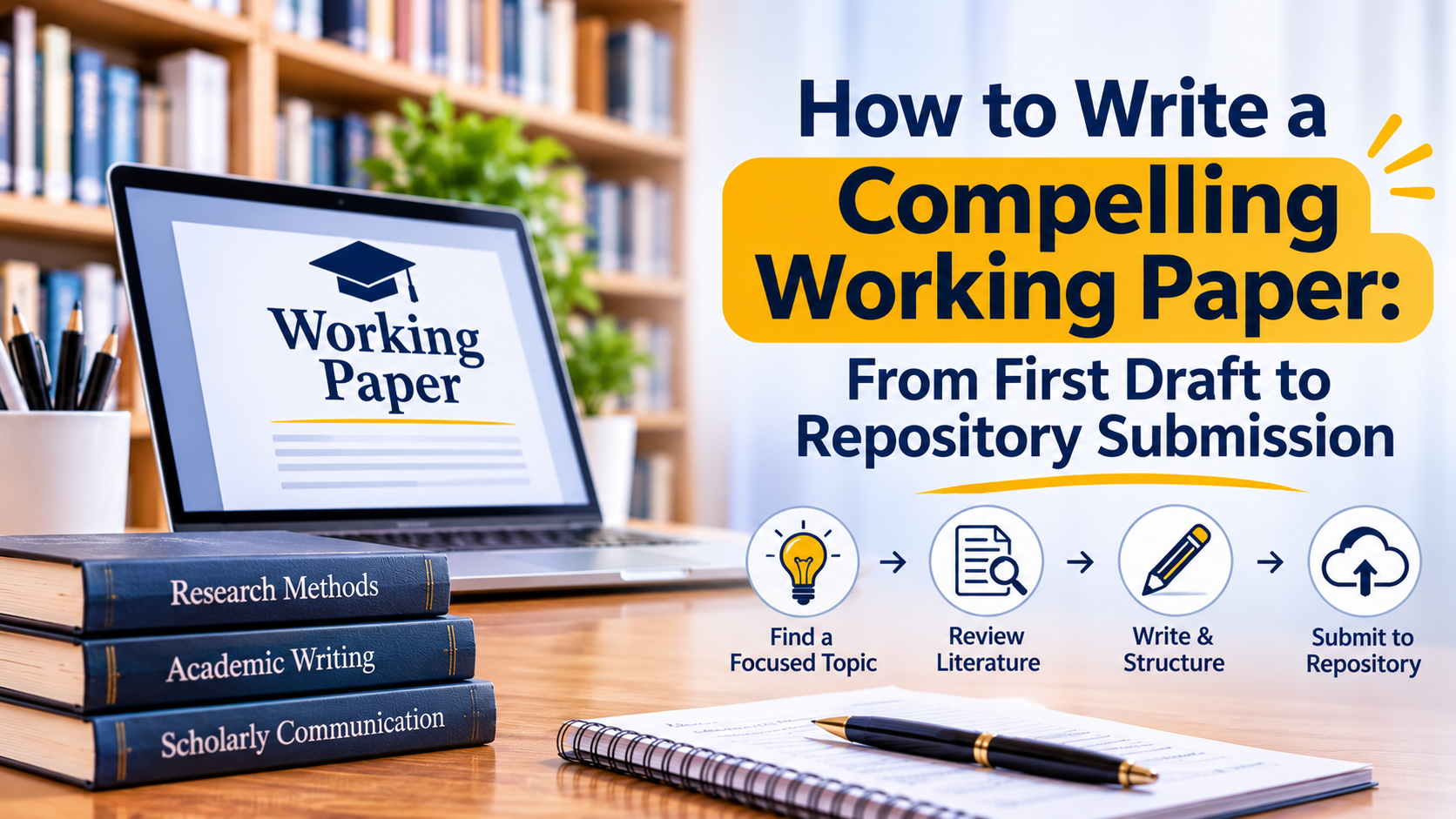
How to Write a Compelling Working Paper: From First Draft to Repository Submission
Introduction: Turning Your Research Into a Compelling Working Paper
A strong research idea deserves a clear, well-organized presentation. Whether you are a doctoral student developing your first manuscript or an experienced academic sharing new findings, learning how to write a working paper is an important step in scholarly communication.
A working paper presents research, analysis, or an argument in a form that readers can examine and discuss. Researchers often share working papers before submitting them to a journal or while a project is still developing. Repositories such as the Social Science Research Network (SSRN) provide opportunities to disseminate eligible scholarly manuscripts to a wider academic audience.
However, a working paper is not automatically a peer-reviewed article. Repository posting does not guarantee acceptance by a journal, and submissions must meet the relevant platform's requirements.
The key to a compelling working paper is combining a meaningful research question, a clear argument, credible evidence, transparent methods, and careful writing.
This guide explains how to develop your first draft, organize the manuscript, revise it for clarity, and prepare it for responsible repository submission.
1. Start With a Focused Research Question
Every effective working paper begins with a research question that is specific enough to investigate and important enough to justify the reader's attention.
Broad topics such as economic inequality, education policy, or digital transformation can generate useful research, but they are usually too wide to guide a single paper without further refinement.
Define the Problem You Want to Investigate
Begin by identifying the problem, debate, or gap in existing research that your paper addresses.
For example:
Broad topic: The effect of technology on education.
More focused question: How does access to digital learning resources relate to student participation in rural secondary schools?
The second question identifies a particular relationship, population, and context. It gives the author a clearer starting point for selecting relevant literature, defining variables, and choosing a research design.
Before drafting, ask yourself:
- What specific problem does this paper investigate?
- Why does the question matter to the field?
- What do existing studies already tell us?
- What remains uncertain or insufficiently understood?
- What evidence can my study contribute?
Your research question should align with the evidence you actually have. Avoid promising conclusions that your data or methodology cannot support.
Practical takeaway: Write your research question in one sentence. If it contains several unrelated problems, consider narrowing the scope or dividing the project into separate papers.
2. Review the Literature and Identify Your Contribution
A working paper should do more than summarize existing studies. It should explain how its research question connects to the scholarly conversation and what readers can learn from the analysis.
Organize Literature Around Ideas, Not Just Authors
Read relevant research and group it by themes, theories, methods, or competing explanations.
For example, a paper on digital learning in rural schools might examine three strands of literature:
- Research on internet access and educational inequality.
- Studies of digital learning tools and student participation.
- Evidence about differences between rural and urban educational settings.
This structure helps you identify where studies agree, where findings differ, and what remains unresolved.
Use reliable academic sources and verify every reference. Keep accurate notes so that claims can be traced to their original publications.
Explain What Your Paper Adds
Your contribution might involve new data, a different geographical setting, a methodological improvement, a fresh interpretation of existing evidence, or a synthesis that clarifies a debate.
Avoid describing your study as the first or only investigation unless you have sufficient evidence to support that claim.
Practical example: Rather than stating that "no research has examined digital learning," explain that existing studies have focused primarily on urban institutions, while your paper investigates access and participation in rural secondary schools.
A precise contribution statement helps readers understand why the paper is worth reading.
3. Structure Your Working Paper Clearly
A logical structure makes a manuscript easier to evaluate, discuss, and revise. Although conventions differ across disciplines, many empirical working papers use a recognizable academic structure.
Recommended Working Paper Format
Title and author information: Choose a descriptive title and provide accurate author names and affiliations.
Abstract: Summarize the research question, approach, principal findings, and contribution.
Introduction: Explain the problem, establish its importance, state the research question, and preview the paper's contribution.
Literature review or theoretical framework: Discuss relevant scholarship and establish the conceptual foundation.
Methods or research approach: Explain how the evidence was collected, selected, or analyzed.
Results or analysis: Present findings in a logical order, using tables or figures when helpful.
Discussion: Explain what the findings mean, how they relate to previous research, and what limitations readers should consider.
Conclusion: Summarize the main contribution and identify appropriate implications or future research directions.
References and appendices: Provide complete references and supporting material where relevant.
Not every paper requires every section. A theoretical essay, legal analysis, qualitative study, and quantitative investigation may need different structures.
Make Headings Informative
Instead of using vague headings such as "Section Two," use headings that describe the content, such as "Data and Research Design" or "Patterns in Regional Employment."
Clear headings help readers navigate the argument and identify relevant sections quickly.
4. Write an Abstract That Communicates the Main Contribution
The abstract may be the first substantial part of your paper that a potential reader encounters. It should provide enough information for readers to decide whether the manuscript is relevant to their work.
Include the Essential Elements
A useful abstract generally explains:
- The research problem or question.
- The purpose of the study.
- The data, method, or analytical approach.
- The principal findings, where available.
- The contribution and significance of the work.
Follow the word limit and formatting requirements of the intended journal or repository.
Example of a weak abstract opening:
"This paper discusses technology and education, which are important topics in today's world."
Stronger alternative:
"This paper examines the relationship between access to digital learning resources and student participation in rural secondary schools, focusing on differences in connectivity and resource availability."
The revised opening identifies the subject and research focus without relying on broad claims.
Do not invent results to make an abstract more compelling. If the work is theoretical or still developing, accurately describe its purpose and current contribution.
Practical takeaway: Draft your abstract after the main argument and findings are reasonably stable, then revise it alongside the title.
5. Present Your Methods and Evidence Transparently
Readers need to understand how you reached your conclusions. A persuasive argument is not enough if the underlying evidence and analytical process remain unclear.
Explain How the Research Was Conducted
Depending on your discipline, describe the data sources, sample selection, research design, analytical techniques, theoretical assumptions, or interpretive framework.
For a quantitative study, explain the key variables, model choices, and important limitations. For qualitative research, clarify how participants or documents were selected and how the material was analyzed.
For a theoretical paper, identify the assumptions and reasoning that support the argument.
Practical example: If your paper uses a survey of teachers, report how participants were recruited, the relevant sample characteristics, and the limits of generalizing the results to other populations.
Use tables and figures to clarify evidence rather than decorate the manuscript. Give each one a clear title, label, and explanation in the text.
If data or code cannot be shared because of privacy, licensing, or ethical restrictions, explain the limitation where appropriate. Never expose confidential information simply to make a paper appear more transparent.
6. Revise the First Draft for Clarity and Academic Quality
A first draft is a starting point, not a finished manuscript. Revision helps ensure that the paper presents a coherent argument and that each section contributes to its purpose.
Check the Argument Before Editing Sentences
First, review the overall logic:
- Does the introduction establish a clear problem?
- Does the literature review explain the relevant research gap?
- Do the methods address the research question?
- Do the findings support the claims being made?
- Does the conclusion reflect the actual evidence?
Then edit for clarity, consistency, grammar, and unnecessary repetition.
Replace vague statements with specific explanations. Define technical terms when readers may not know them, and distinguish correlation from causation when interpreting empirical results.
Ask a Colleague to Review the Manuscript
A colleague who works in a related field can help identify unclear reasoning, missing literature, or sections that assume too much background knowledge.
Ask reviewers to focus on specific questions, such as whether the contribution is clear or whether the methods are sufficiently explained.
If you use AI-assisted writing or editing tools, verify all generated text, references, quotations, and factual claims. Follow the requirements of your institution, funder, journal, and intended repository. SSRN's current submission guidelines require an AI disclosure statement when AI has been used, subject to the platform's stated exceptions. <Cite refs={["turn855643search0"]}/>
7. Prepare Your Manuscript for Repository Submission
Once the working paper is ready, identify a suitable repository and review its current requirements before uploading the file.
Check SSRN's Submission Requirements
SSRN requires a free user account and complete author information for submissions. Its published guidance also identifies a paper title, writing date, abstract or summary, author names and affiliations, relevant copyright permissions, and a full-text PDF in English among the submission requirements. An AI disclosure statement is also required when applicable. <Cite refs={["turn855643search0"]}/>
Before submitting:
- Confirm that the paper meets the repository's eligibility requirements.
- Prepare a readable PDF containing the title and author details.
- Check that the abstract accurately summarizes the manuscript.
- Confirm that every co-author has agreed to the submission.
- Provide accurate affiliations and contact details.
- Include relevant funding, ethics, and conflict-of-interest disclosures.
- Check that citations, tables, figures, and supplementary material are complete.
SSRN does not accept every type of document. Its guidelines describe content categories that may be ineligible and explain that submissions can be declined for policy or research-integrity reasons. Review the current rules rather than assuming any academic-looking document will qualify. <Cite refs={["turn855643search0"]}/>
Verify Copyright and Sharing Rights
If the paper has been submitted to or published by a journal, determine which version you are permitted to share.
Publisher policies can distinguish between a submitted manuscript, an accepted manuscript, and the final published version. Embargoes or other conditions may apply.
SSRN states that uploading a paper does not transfer the author's copyright, but authors grant SSRN a non-exclusive right to post and distribute the submission. Authors must still have the necessary rights to share the material. <Cite refs={["turn855643search1"]}/>
Check your publishing agreement, repository terms, and any permissions needed for third-party figures, tables, or reproduced content.
8. Help Readers Discover Your Working Paper
After submission, make it easier for the relevant research community to find and understand your work.
Use an accurate title and abstract, appropriate subject classifications, and relevant keywords where the platform allows them. Maintain consistent author information and researcher identifiers, such as an ORCID iD.
You can also share the paper through suitable academic seminars, professional networks, conferences, and research groups.
For example, a working paper on regional labor markets may be relevant to economists, public-policy researchers, and development scholars. Sharing it with communities that genuinely work on these topics may encourage useful discussion.
Avoid exaggerated promotional claims. Explain the paper's actual contribution and identify its status accurately.
Remember that repository posting is a dissemination step, not proof of peer review or journal acceptance. If the manuscript is later published, update the relevant record or provide a link to the formal publication when the platform and applicable policies permit.
Working Paper Preparation Checklist
Use this checklist before submission:
- The research question is focused and clearly stated.
- The literature review explains the paper's contribution.
- The manuscript follows a logical structure.
- The abstract accurately describes the research.
- The methods and evidence are explained transparently.
- The claims are supported by the findings.
- References and citations have been checked.
- All co-authors have approved the submission.
- Copyright and manuscript-version permissions have been reviewed.
- Required disclosures and author details are included.
- The PDF is readable and follows repository instructions.
- The paper meets the repository's current eligibility rules.
Frequently Asked Questions About Writing Working Papers
1. What is an academic working paper?
An academic working paper is a scholarly manuscript that presents research, analysis, or an argument for discussion and dissemination. It may be shared before journal submission, during peer review, or while the research is being developed. Its exact status depends on the project and publication history.
2. How long should a working paper be?
There is no universal word count. Length depends on the discipline, research question, methods, and intended audience. Aim to provide enough detail to explain the argument and evidence without unnecessary repetition. Follow any relevant journal, department, or repository requirements.
3. Can I submit a working paper to SSRN before journal publication?
Potentially, yes, if the manuscript meets SSRN's current eligibility and submission requirements and you have the necessary rights to share it. You should also review the target journal's preprint policy and obtain agreement from all co-authors.
4. Does SSRN peer-review working papers?
No. SSRN's repository posting process is not the same as a journal's formal peer-review process. A manuscript appearing on SSRN should not automatically be described as peer-reviewed or accepted for journal publication.
5. Can I upload a published article to SSRN?
That depends on the publisher's rights and self-archiving policy, the manuscript version, and any embargo or other conditions. Check the applicable publishing agreement and SSRN's current copyright guidance before uploading.
6. What makes a working paper compelling?
A compelling working paper has a focused research question, a clear contribution, a logical structure, transparent methods, credible evidence, and conclusions that reflect the findings. Readability and accurate metadata also help readers assess its relevance.
7. Should I use AI to help write my working paper?
AI tools may assist with tasks such as language editing or outlining, but researchers remain responsible for accuracy, originality, references, and scholarly integrity. Follow institutional and publisher policies, protect confidential information, and meet repository disclosure requirements where applicable.
Conclusion: Turn Your Research Into a Clear, Shareable Contribution
Writing a compelling working paper requires more than assembling research findings. It involves identifying a meaningful question, understanding the relevant literature, explaining the contribution, presenting evidence transparently, and revising the manuscript until its argument is clear.
Repository submission adds another important responsibility: choosing an appropriate platform, confirming co-author agreement, following copyright rules, and meeting current submission requirements.
SSRN can provide a route for sharing eligible scholarly manuscripts with a wider research audience, but repository posting does not replace peer review or guarantee journal acceptance.
Ready to prepare your working paper? Start with the research question, use the checklist above to assess the manuscript, and review the official submission instructions before uploading your PDF.
A well-prepared paper gives readers a clearer opportunity to understand your work, evaluate its contribution, and build on your research.
