


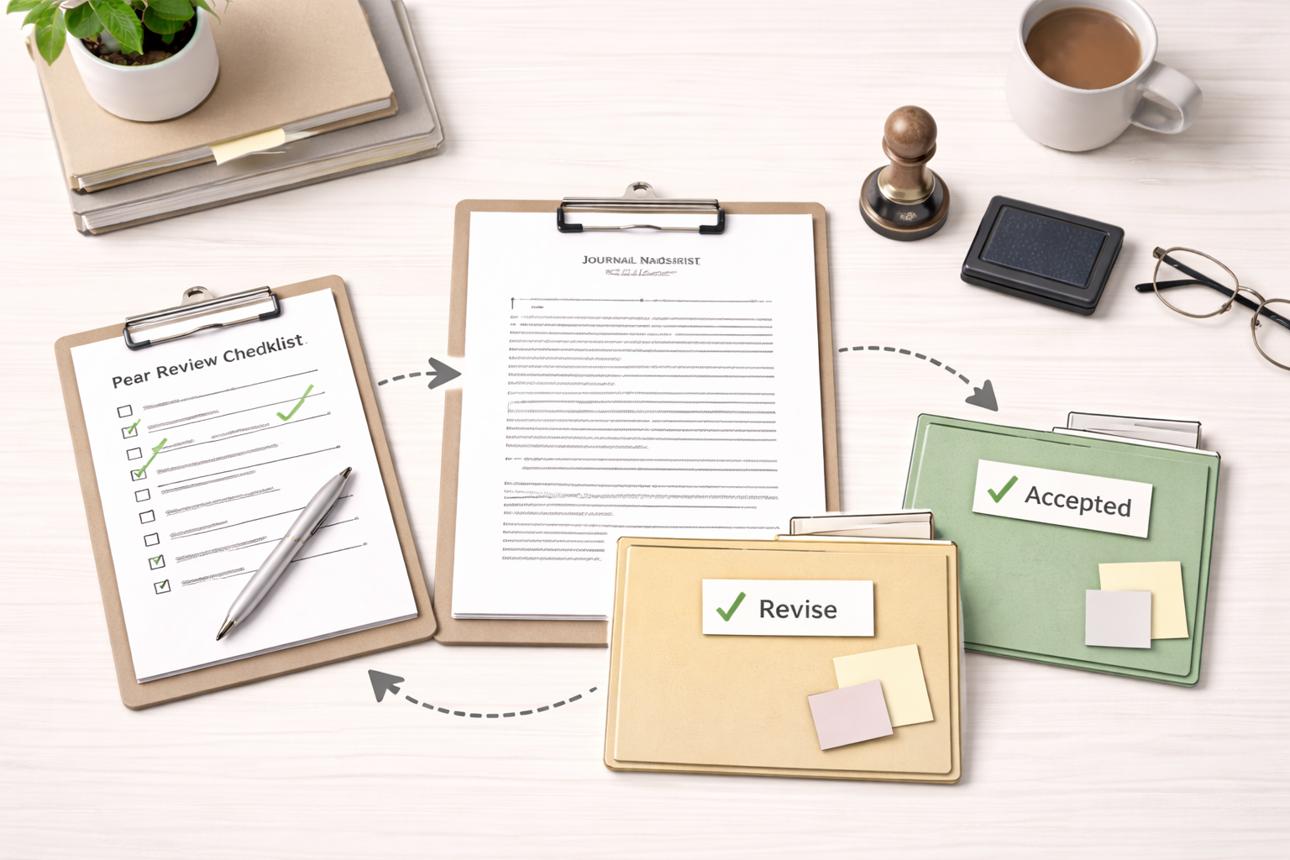
Navigating the Peer Review Process: Common Pitfalls and How to Avoid Rejection
Introduction
Getting a research paper published in an academic journal is an important milestone for researchers, faculty members, and graduate students. However, navigating the academic peer review process can be challenging, particularly for early-career researchers preparing their first journal submission.
Even well-researched manuscripts may receive negative feedback or rejection. Common reasons include unclear research questions, methodological weaknesses, limited engagement with existing literature, poor journal selection, and failure to follow submission guidelines.
The good news is that many of these problems can be addressed before submission. Understanding how peer review works, anticipating reviewers' concerns, and responding constructively to feedback can help researchers strengthen their manuscripts and navigate the publication process more confidently.
In this guide, we explain the academic peer review process, explore common reasons for manuscript rejection, and provide practical strategies for improving your chances of getting published.
What Is the Academic Peer Review Process?
Academic peer review is a quality-assessment process in which experts evaluate a research manuscript before a journal decides whether to publish it. Reviewers typically examine the originality, relevance, methodology, evidence, interpretation, and clarity of the research.
The precise process varies by journal and discipline, but the main objective is to help editors determine whether a manuscript meets the journal's standards and makes a meaningful contribution to its field.
Common types of peer review
- Single-anonymous peer review: Reviewers know the authors' identities, but authors do not know the reviewers' identities.
- Double-anonymous peer review: Authors and reviewers are not informed of each other's identities, although complete anonymity cannot always be guaranteed.
- Open peer review: Reviewer identities, review reports, or author responses may be disclosed, depending on the journal's policy.
Some journals use other review models or combine different approaches. Authors should consult the journal's website to understand its specific process.
How Does the Journal Submission Process Work?
Knowing what happens after submission can help researchers plan their next steps and understand editorial decisions.
Step 1: Select an appropriate journal
Identify journals that publish research related to your topic, methodology, and intended audience. Read their aims and scope, review recent articles, and check their submission requirements.
Step 2: Submit your manuscript
Prepare the manuscript, abstract, references, tables, figures, and supplementary materials according to the journal's instructions. Include any required cover letter, declarations, ethics statements, and author information.
Step 3: Undergo an initial editorial screening
The editor assesses whether the submission fits the journal's scope and meets its basic standards. Manuscripts may be rejected at this stage without external peer review. This is commonly called a desk rejection.
Step 4: Proceed to external peer review
If the manuscript passes the initial screening, the editor may invite subject experts to evaluate it. Reviewers provide comments and recommendations, which inform the editor's decision.
Step 5: Receive an editorial decision
Common decisions include rejection, major revision, minor revision, or acceptance. Some journals use additional decision categories or multiple rounds of review.
Step 6: Revise and resubmit
If revisions are invited, carefully address the editor's and reviewers' comments. Submit a revised manuscript and a detailed response explaining how each concern was handled.
Step 7: Complete publication requirements
After acceptance, authors may need to review proofs, confirm publication agreements, provide final files, and verify author and funding information.
The timeline varies substantially across journals. Researchers should avoid assuming that every manuscript will follow the same schedule.
7 Common Reasons Why Academic Papers Get Rejected
Understanding the most frequent problems in academic publishing can help researchers identify weaknesses before submitting their work.
1. Choosing the Wrong Journal
A strong paper may be rejected if it does not fit the journal's subject area, readership, or editorial priorities.
For example, a highly technical economics paper may not be suitable for a journal focused primarily on accessible policy commentary, even if the underlying research is rigorous.
How to avoid this mistake:
- Read the journal's aims and scope.
- Review recently published papers on related topics.
- Check whether the journal publishes your research method and article type.
- Confirm the journal's formatting and submission requirements.
Journal selection should be based on research fit and publication standards rather than impact factor alone.
2. Failing to Establish a Clear Research Contribution
Editors and reviewers need to understand what a study adds to existing knowledge. A manuscript that summarizes previous research without identifying a meaningful contribution may struggle to gain acceptance.
How to avoid this mistake:
Clearly explain the research problem, the gap in existing literature, and the contribution your study makes. State your research questions or hypotheses explicitly and show how your findings extend, challenge, or refine previous work.
Avoid claiming that your study is the first of its kind unless you have conducted a sufficiently comprehensive literature review to support that statement.
3. Weak Research Methodology
A manuscript may be rejected when its methods do not adequately answer the research question or when important methodological decisions are insufficiently explained.
Common problems include inappropriate sampling, unclear variable definitions, weak research instruments, inadequate robustness checks, and conclusions that go beyond the available evidence.
How to avoid this mistake:
- Explain why your chosen method is appropriate.
- Describe data sources, sample selection, and analytical procedures.
- Justify important assumptions.
- Address relevant limitations and potential biases.
- Report sufficient detail for readers to assess the credibility of your findings.
For empirical research, ensure that the analyses support the claims made in the discussion and conclusion.
4. An Incomplete or Outdated Literature Review
A literature review should do more than list previous studies. It should establish the scholarly context, identify important debates, and demonstrate how the current study relates to existing evidence.
How to avoid this mistake:
Use relevant and credible scholarly sources, including important foundational studies and recent work where appropriate. Compare findings across studies, identify unresolved questions, and explain how your research contributes to the discussion.
Do not add citations simply to increase the reference count. Each source should serve a clear purpose in developing your argument.
5. Poor Structure and Academic Writing
Even a valuable study can be difficult to evaluate if the manuscript is disorganized or unclear.
Long, repetitive paragraphs, undefined terminology, weak transitions, inconsistent references, and unclear figures can prevent reviewers from understanding the contribution.
How to avoid this mistake:
Use descriptive headings and a logical structure. Keep the introduction focused, define important concepts, present results clearly, and distinguish findings from interpretation.
Ask a colleague to read the manuscript before submission. A fresh reader may identify unclear arguments or missing explanations that the author has overlooked.
6. Ignoring Journal Guidelines
Failure to follow submission instructions can delay the review process or lead to rejection before external review.
Examples include incorrect manuscript formatting, missing declarations, incomplete references, inappropriate file types, and failure to anonymize a manuscript when required.
How to avoid this mistake:
Download the journal's current author guidelines and use them as a checklist. Verify word limits, reference style, figure requirements, supplementary materials, ethics statements, and anonymization rules.
Also confirm that all authors approve the submitted version and that the manuscript is not under simultaneous consideration by another journal when exclusive submission is required.
7. Overstating the Findings
Reviewers may question a paper when its conclusions extend beyond what the research design or evidence can support.
For example, an observational study may identify an association between two variables without establishing that one causes the other.
How to avoid this mistake:
Use appropriately qualified language, acknowledge uncertainty, and discuss alternative explanations. Distinguish correlation from causation and identify limitations that could affect the interpretation of results.
Transparent reporting generally strengthens a manuscript more than exaggerated claims of significance.
How to Respond to Peer Review Comments Effectively
Receiving reviewer comments can be stressful, especially when the feedback is critical. However, a revision request is an opportunity to improve the manuscript and clarify its contribution.
1. Read All Comments Before Responding
Read the editor's decision letter and all reviewer reports carefully. Avoid drafting immediate responses while frustrated. Identify recurring concerns and separate substantive methodological issues from presentation-related suggestions.
2. Prepare a Point-by-Point Response
Create a response document that reproduces or summarizes each comment and explains how you addressed it.
For every comment:
- Thank the reviewer for the feedback where appropriate.
- Explain the change made to the manuscript.
- Identify the relevant section or page when possible.
- Provide a reasoned explanation if you disagree with a suggestion.
3. Make Revisions Easy to Identify
Follow the journal's instructions for highlighting changes. You may be asked to submit both a clean manuscript and a tracked-changes version.
Clear revisions help the editor and reviewers assess how the paper has improved.
4. Respond Professionally to Disagreement
You do not need to accept every reviewer suggestion automatically. If a recommendation is inappropriate or unsupported, explain your position respectfully and provide evidence or methodological justification.
Where possible, revise the manuscript to address the underlying concern, even if you do not adopt the proposed solution.
5. Meet the Revision Deadline
Review the deadline in the decision letter. If additional time is genuinely needed, contact the editor before the deadline and request an extension.
A carefully prepared response is generally more useful than a rushed revision that leaves important concerns unresolved.
What Should You Do After a Rejection?
Rejection is a common part of academic publishing and does not necessarily mean that the research has no value.
First, determine whether the decision reflects a fundamental concern about the study or a mismatch with the journal's scope and priorities.
Then take the following steps:
- Read the editor's decision and reviewer comments carefully.
- Identify issues that can be addressed through clearer writing, additional analysis, or stronger justification.
- Discuss substantive feedback with a supervisor or experienced colleague if appropriate.
- Revise the manuscript before submitting it elsewhere.
- Identify another suitable journal based on scope, readership, and publication standards.
If the manuscript is rejected without external review, reassess journal fit and the clarity of the contribution. If reviewers identify methodological weaknesses, address those concerns before resubmission.
Always check the previous journal's policies and make any required disclosures when submitting a revised manuscript to a new venue.
The Role of Preprints and Working Papers in Academic Publishing
Preprints and working papers can help researchers share findings and receive feedback before or alongside the formal journal publication process.
Platforms such as the Social Science Research Network (SSRN) enable authors to circulate research papers to interested readers and scholarly communities.
Sharing a working paper may help researchers identify unclear arguments, discover related research, and connect with potential collaborators. However, posting a paper does not mean that it has passed peer review or been accepted by a journal.
Before uploading a manuscript, authors should:
- Check the target journal's preprint and self-archiving policies.
- Obtain approval from all coauthors.
- Follow applicable copyright and licensing requirements.
- Protect confidential, personal, or otherwise restricted information.
- Label the manuscript's publication status accurately.
- Update the repository record when a published version becomes available, where permitted.
Preprints can complement formal peer review, but they do not replace it.
A Practical Pre-Submission Checklist for Researchers
Before submitting your next manuscript, use this checklist to catch common problems.
- The research question and contribution are clearly stated.
- The journal is appropriate for the topic and intended audience.
- The literature review covers relevant foundational and recent research.
- The methodology is appropriate, transparent, and adequately explained.
- The results support the conclusions.
- Limitations and uncertainties are acknowledged.
- References, tables, figures, and supplementary files are complete.
- Ethical approval, consent, funding, and conflict-of-interest disclosures are included where required.
- All authors have approved the final manuscript.
- The manuscript follows the journal's submission and anonymization guidelines.
- Any preprint or prior dissemination complies with the journal's policies.
- The cover letter accurately describes the paper's contribution.
- The manuscript is not simultaneously submitted elsewhere when exclusive submission is required.
A final review of these details can prevent avoidable administrative problems and help editors focus on the quality of your research.
Conclusion
Navigating the academic peer review process requires careful preparation, a suitable journal choice, transparent methodology, and a willingness to improve your work through feedback.
Although rejection can be discouraging, understanding common pitfalls allows researchers to strengthen their manuscripts and make more informed publication decisions. A clear research contribution, well-explained methods, accurate reporting, and a professional response to reviewers can all improve the quality of a submission.
For early-career researchers and graduate students, learning these skills is an important part of developing as a scholar. For experienced academics, they remain essential to maintaining high standards of research communication.
Your next step: Before submitting your next paper, review the journal's aims and scope, complete the pre-submission checklist, and ask a colleague to provide feedback on your manuscript.
Successful academic publishing is not simply about avoiding rejection. It is about producing reliable research, communicating it clearly, and contributing meaningfully to the ongoing scholarly conversation.
